
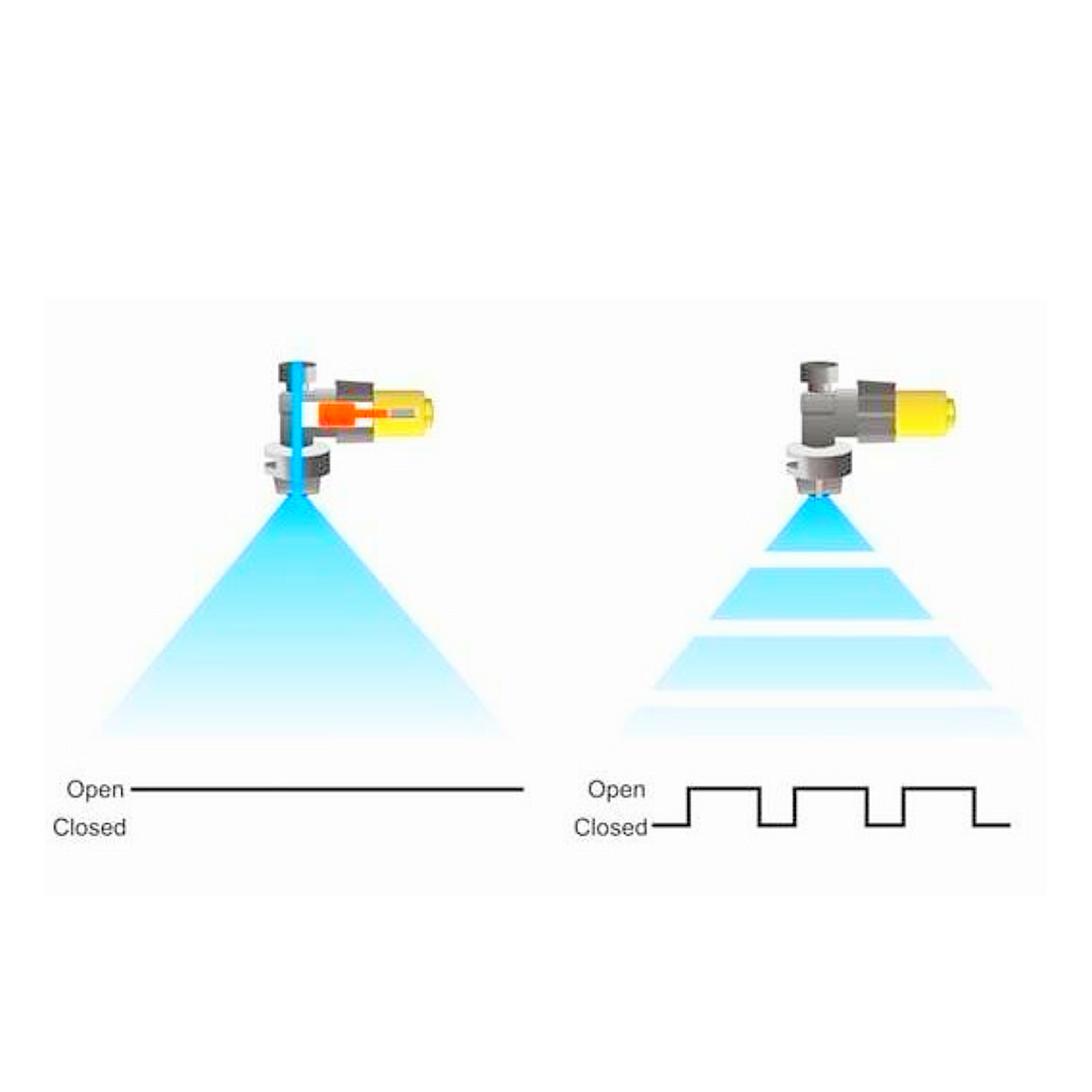
Pulse width modulation (PWM) has changed what is possible with modern spraying equipment. By controlling flow at individual nozzles, PWM systems can help maintain a selected operating pressure as application rates and travel speeds change. They can also support functions such as turn compensation and individual nozzle shut-off, depending on the system.
But fitting PWM valves does not automatically improve an application. The result still depends on nozzle selection, spray quality, duty cycle, boom setup and how well the technology integrates with the sprayer. Understanding those details is what separates an impressive feature list from a system that performs in the field.
How PWM spraying works
On a conventional pressure-regulated sprayer, changing pressure is a common way to change nozzle flow. With PWM, an electrically operated valve rapidly opens and closes to control the average flow through each nozzle. This allows the system to vary application rate while maintaining a selected supply pressure over its usable operating range.
The proportion of time the valve is open is called the duty cycle. At 80% duty cycle, the valve is commanded open for 80% of each pulse cycle. Pulse frequency, measured in hertz (Hz), describes how many times the valve cycles each second. The actual flow and spray pattern also depend on valve response, nozzle type, pressure and system design.
Some systems stagger the timing between neighbouring nozzles to improve spray-pattern blending. Even with this arrangement, coverage needs to be checked across the intended speed and duty-cycle range.
Why pressure and spray quality still matter
One of PWM's advantages is the ability to change flow without relying entirely on pressure changes. That can help maintain more consistent spray quality across a range of speeds and application rates. It does not mean that droplet size stays identical in every operating condition, or that PWM eliminates spray drift.
Nozzle design, operating pressure, boom height, travel speed, weather and the chemical label all remain important. Pressure at the nozzle can also fluctuate briefly as the valve opens and closes, even when the boom supply pressure appears steady. This is particularly worth considering with pre-orifice and air-induction nozzles, where compatibility should be confirmed with the nozzle and system manufacturers.
The objective is not simply to maintain a number on the pressure gauge. It is to achieve the required application rate, spray quality and coverage under real operating conditions.
Turn compensation and individual nozzle control
When a sprayer turns, the outside of the boom travels faster than the inside. On systems equipped with turn compensation, nozzle output can be adjusted across the boom to help account for those differences in ground speed.
Other functions, such as individual nozzle shut-off, variable-rate control and integration with camera-based detection systems, depend on the hardware, software and controller configuration.
Turn compensation demonstration. The functions available depend on the particular spraying system and configuration.
Getting the nozzle and duty cycle right
The GRDC's June 2026 Pulse Width Modulation Sprayers fact sheet provides a useful starting point for selecting nozzles and checking PWM performance. A key consideration is choosing a nozzle that allows the system to operate at a sufficiently high duty cycle during normal spraying.
GRDC discusses a normal operating range of around 70–95% duty cycle, with approximately 75% or higher a useful target at the intended field speed. At lower duty cycles, particularly below about 50–60%, longer periods between pulses can increase the risk of uneven coverage or missed strips. This can become more noticeable at lower travel speeds, with larger droplets or where spray-pattern overlap is limited.
Higher pulse frequencies can reduce the distance travelled while a nozzle is closed, but frequency alone does not solve poor nozzle selection or boom setup. It is important to check the lowest and highest speeds at which the sprayer will actually operate.
Calculating flow per nozzle
The starting point is the same basic flow calculation used for conventional boom spraying:
Flow (L/min per nozzle) = Speed (km/h) × Application rate (L/ha) × Nozzle spacing (m) ÷ 600
For example, at 18 km/h, 80 L/ha and 50 cm nozzle spacing:
18 × 80 × 0.50 ÷ 600 = 1.20 L/min per nozzle
For PWM, the selected nozzle needs enough capacity at the intended pressure to deliver that average flow while operating within a suitable duty-cycle range. GRDC's worked example considers a larger 04 nozzle at 3 bar, delivering approximately 105 L/ha at 100% duty cycle. Operating at around 77% duty cycle brings the average application back towards 80 L/ha. This illustrates the selection method; the final nozzle choice depends on the actual equipment and application requirements.
Checking spray coverage in the field
Coverage should be checked at representative speeds, boom heights, pressures and duty cycles, including slower operation around headlands. Water-sensitive paper can help identify uneven distribution and gaps that may not be obvious from the cab.
Spray-pattern shape also matters. Tapered-fan and even-fan nozzles distribute liquid differently, particularly in spot-spraying applications where a single nozzle may be activated briefly. Dave Young discusses these differences in his comparison of tapered-fan and even-fan nozzles for PWFM spot spraying.
For further discussion of drift management and air-induction nozzle considerations, see Dave's PWM versus air induction article. Spray quality and drift management must be assessed for the complete application setup, not just the type of control system fitted.
Comparing PWM technology options
There are several established PWM spraying systems available, including ARAG Flowtron, CapstanAG PinPoint III ENVELOP, Ag Leader RightSpot, BBLeap, TeeJet and Raven Hawkeye, to name a few.
While the underlying principles are similar, each system approaches nozzle control, operating range and machine integration differently. Some offer additional functions or different ways of managing pulsed and non-pulsed operation. Dave Young's discussion of John Deere ExactApply Auto Select is one example of why it is worth understanding how a system actually operates rather than comparing features on a brochure alone.
ARAG Flowtron
ARAG Flowtron is an ISOBUS-based PWM system using an IBX100 controller, Cable Smart Drivers (CSDs) and electrically operated nozzle valves. Depending on the configuration, it can support individual nozzle shut-off, variable-rate application and integration with camera-based detection technology such as CarbonBee SmartStriker X.
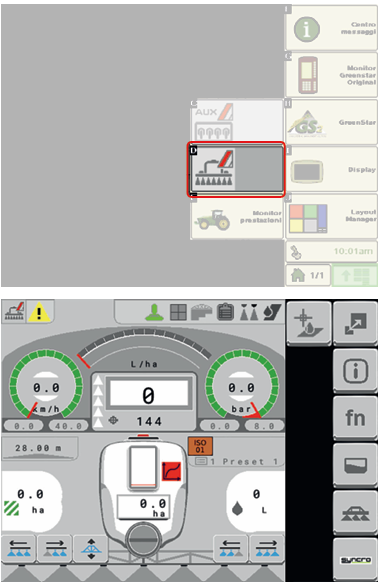
ARAG Flowtron ISOBUS PWM system.
What to consider before retrofitting a sprayer
A successful retrofit starts with understanding the machine and the application, not just selecting a PWM product. We look at the existing plumbing, nozzle spacing, boom configuration, controller and electrical system alongside the rates, speeds and spray qualities the operator needs to achieve.
It is also worth establishing which features are genuinely required. Individual nozzle shut-off, turn compensation, variable-rate control and camera-based spot spraying are different functions, and they do not automatically come together in every system.
For a practical introduction to selecting nozzles for pressure-regulated, PWM and three-tier boom sprayers, Dave Young's broadacre nozzle-selection guide using SpraySpotter.app covers application rate, pressure, spray quality and duty cycle. His duty-cycle calculator article is another useful reference. These tools can help narrow the options, but nozzle charts, equipment compatibility and field checks still matter.
Bridging the gap between technology and practical application
With so much information available, it can be difficult to separate what a technology is marketed to do from what it can realistically achieve in the field. Nozzle selection, plumbing, electronics, software, machine compatibility and setup all influence the result.
This is where experience across multiple brands, control systems and machinery platforms becomes valuable. At METLAN, we work across different technologies and manufacturers, giving us a broader understanding of how systems operate, where they perform well and where integration challenges can arise.
Our focus is on helping customers understand their options, make informed decisions and get the most from the equipment they invest in.
It's not just about what the technology promises. It's about making it work in the field.
Explore ARAG Flowtron and ARAG precision agriculture, or contact METLAN Distribution to discuss your sprayer and application requirements.
Technical references and further reading
- GRDC — Pulse Width Modulation Sprayers, June 2026 fact sheet.
- Dave Young — Concise Pulse Width Modulation Guide
- Dave Young — Broadacre nozzle selection with SpraySpotter.app
- Dave Young — Duty Cycle Apps and Spray Calculators
- Dave Young — PWFM tapered fan versus even fan
- Dave Young — PWM versus Air Induction for Drift Management and Coverage
- Dave Young — ExactApply Auto Select (PWM and non-PWM)
- ARAG — Flowtron product information
Always follow the applicable spray product label and confirm nozzle compatibility, operating settings and spray quality for the equipment in use.